Hayden Jones
Professor Horace Campbell
PSC 306
November 20, 2025
The U.S. Racial Caste System through Politics, Racism, and the Prison-Industrial Complex
There is a strong correlation between politics, racism, and the prison-industrial complex. They are all deeply related to each other through a racial caste system, and the relationship between them has been shown through U.S. history of the struggle of the Black American and U.S. capitalism.
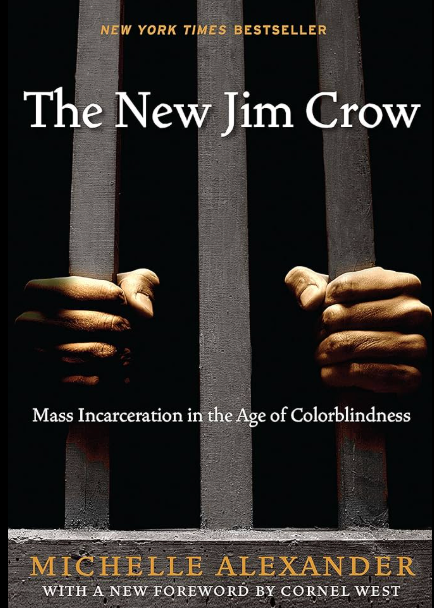
In the book “The New Jim Crow: Mass Incarceration in the Age of Blindness”, the author walks us through history to explain the racial caste system and its rebirth. M. Alexander explains that, as a racial caste system is on the brink of failure, the seeds of a new one are planted. The first racial caste system that the author describes is slavery, and how slavery was used to hold power over slaves, and place Black people at the bottom of the U.S. social hierarchy. Slavery was then justified through the white elites' constructed idea of race. This idea of race was to promote that Black people were inferior compared to whites, and was used to maintain power over the enslaved. This white elitist idea of race was intentional so that large landowners, political leaders, and wealthy industrial businessmen could capitalize on slavery to advance economic wealth and political power. Slavery was used to produce wealth for landowners from cotton picking, tobacco production, and textile production. Enslaved people would produce the wealth; however not receive any of it, as white elites would take all the capital made off their work. And to keep plantation owners' capital and wealth, they would enforce quotas that would increase every day. Not only did they use quotas to capitalize on personal wealth, but used quotas as a way to justify the punishments that slaves endured. Plantation owners would use terror tactics and violence to reinforce the racial caste system and suppress resistance from the slaves. Slavery within the United States was created not only as a labor system but also designed to increase personal wealth and control the Black body. The racial caste system during slavery was not only maintained through white elite racism or white capitalism, but also through racist law. In the U.S. Constitution and politics, the Constitution defined slaves as “3/5ths” of a person, knocking them down to property and not being able to be defined as a whole human being. The 3/5ths compromise was used to strengthen the racial caste system by silencing enslaved people and reinforcing that slaves had no rights, no political power, and no citizenship. However, counting enslaved people as 3/5ths of a person for representation in Congress only gave more political power to the South and white southern elites, so that they were able to block anti-slavery legislation and shape policy to favor slavery. Another racist law that was passed to keep slavery active, and involved northern free states, was the Fugitive Slave Act of 1850. This act states that runaway slaves living in a free state could be captured and returned to their owners. This act made the federal government responsible for finding and returning escaped slaves. Specifically, this law strengthened the racial caste system of slavery because it forced free states to participate in slavery, and then nationally enforced a hierarchy of Black people at the bottom. This law criminalized Black freedom and created a legal structure that marked Black people as criminals and property. The act not only reinforced class structure but also protected economic exploitation. These laws were used to dehumanize Black people, normalize slavery as part of American culture, and set up the seeds for the next racial caste system as slavery started to collapse.
As slavery started to collapse and the Emancipation Proclamation was passed, the seeds of a new system had already been long planted before slavery had ended. In the book, M. Alexander described the second racial caste system as the Jim Crow Era. On January 31, 1865, the 13th Amendment of the U.S. Constitution was passed, abolishing slavery and involuntary servitude, unless it was a punishment of a crime committed by the convicted. Following the 13th Amendment, southern states immediately passed Black Codes. In class, Professor H. Campbell defined them as “ laws designed to restrict freed Blacks' activity and ensure their availability as a labor force.” These laws were passed because white southern elites wanted to maintain economic dominance. The laws criminalized unemployment, required all Black people to sign annual labor contracts, and made all jobs besides “farming” illegal. If these laws were not followed by the recently enslaved, they would be arrested and put in prison. However, prisons were not better; they would send inmates out to plantations as a punishment for their crimes. This was known as the Convict Lease System, and it used criminal laws to force Black people into unpaid labor, while still preserving Southern economic dominance. The system that the Black Codes set up made it impossible for Black people to escape slavery. The reassertion of white elitist authority ensured that Black people would stay politically and socially subordinate. The Black Codes were the bridge from slavery to the Jim Crow era. The Jim Crow era was an era of systematic racial segregation and discrimination against African Americans. This was a system designed to protect white supremacy and enforce the social hierarchy. The laws restricted Black people from voting through poll taxes and literacy tests. The laws also enforced segregation in schools, buses, public spaces, and anywhere Black people went. Black people were excluded from the political process, not being able to hold jobs in an office, and were restricted from serving on juries. The laws created a racial prejudice and a system that legally assigned Black people an inferior status. Without slavery, the South’s economic institution was threatened, and so they created a new capitalizing agricultural and industrial system. Southern white elites used sharecropping as a way to manipulate Black people into unpaid labor, while also capitalizing on them. Sharecropping is the agricultural system that boosted the economic state of the South post slavery. It allowed tenants (Black people) to use the land in exchange for crops produced. However, landlords (white plantation owners) would charge tenants crazy amounts, so the tenants never produced a profit, and all the money they made would go into the landlord's pocket. This was another form of indentured servitude, creating a system of economic dependency and perpetual debt. Another central mechanism that further enforced the racial caste system was lynching. Lynching was used to keep Black people silent and incite fear because of their unpredictability and targeting of community leaders. Courts and sheriffs would often ignore lynching and allow it to continue, showing that to protect white supremacy, death would occur. It was also used as a form of social control and enforced the unwritten rules of the racial hierarchy. Lynching was not only a form of eugenics, but also a reminder that the law belonged to the white supremacists. The practice of lynching inspired the establishment of the Kuu Klux Klan in Pulaski, Tennessee. This white elitist group started as a drinking society; however, they slowly moved towards adopting and institutionalizing lynching as their primary method of racial terrorism and white supremacist control. The Ku Klux Klan soon turned into a mass movement and a staple of American life, maintaining and strengthening the racial caste system in the United States. The Ku Klux Klan would kill Black politicians or leaders, destroy Black schools and churches, and focus attacks on the institutions of Black advancement. The struggle for Black American freedom was shaped through the Ku Klux Klan’s attempts to preserve white supremacy and white political power. The Ku Klux Klan was heavily rooted in politics and played a central role in maintaining the racial hierarchy. The Klan would strategically suppress Black voter turnout through inciting fear of death and supporting white supremacist candidates. This tactic signaled that Black American political participation would end in death and demonstrated the monopoly the Klan had in U.S. politics. The Ku Klux Klan would specifically destroy polling places, attack Black elected officials, force Black politicians to step down, attack Black freedom organizers, and vote racist pro-segregation candidates into office. The Klan also worked with local government, judges, and officials, ensuring that they had members in each sector. This meant that police officers were Klan members who would incite violence against Black people, judges were members and refused to prosecute white supremacists for Black deaths, and juries were made up of multiple members and always ruled in favor of the white person. The Ku Klux Klan had infiltrated politics with millions of members placed in the U.S. government. Because so many members were a part of Congress and the government, they would pass racist bills that favored white supremacy and economic dominance, which would capitalize on the Black person’s body/work. The Ku Klux Klan’s dominance in U.S. politics shows that the Klan was politics and that U.S. politics were shaped by racist ideals. The Ku Klux Klan was not just a violent mob, but was a system to maintain the racial caste system, protect white supremacy, keep Black Americans at the bottom of the social hierarchy, and ensure that Black Americans could not participate in American politics. However, the Civil Rights Act dismantled the foundations of the Jim Crow era. During this time, the Ku Klux Klan lost power and was struggling to find another way to protect white supremacy. M. Alexander says that the fall of the Ku Klux Klan and the Jim Crow Era killed the current racial caste system, but led to the seeds of the next one being planted during the Civil Rights Movement.
At the height of the Civil Rights Movement, white elitists were trying to regain power, and they did this through imprisonment. People would be arrested for acts of protest that challenged segregation and voter suppression. M. Alexander argues that mass incarceration is “The New Jim Crow” because mass incarceration was not a response to crime, but a project to reform and maintain the racial hierarchy. This system emerged during the Civil Rights Movement as a direct reaction to Black political progress, demands for equality, and basic human rights. This system labeled Black American protestors as “lawbreakers” and “criminals,” subjecting them to an increase in police brutality. Police brutality was framed as proof that Black communities were violent and disorderly, needing to be condemned. The police and far-right leaders portrayed these moments of police violence as a way to protect public safety. They framed this for the state to use policing and criminal law as a way of social discipline, instead of racial discrimination. Because of this civil unrest, the federal government responded by spending and giving more resources to the police to handle these “violent” and “disturbed” black communities. This is also known as the militarization of the police force, as these police would receive stronger and better weapons, increasing the violence against Black communities. The police would use military tactics to attack and imprison black people. M. Alexander says that this was the first notion of the prison-industrial complex because it criminalized resistance and poorer Black communities. However, the height of the prison-industrial complex did not occur until June 17, 1971, when former President Richard Nixon declared a “War on Drugs”. M. Alexander explains that during this time, the drug rate was going down, not up. She says that this declaration of war on drugs was a ploy to continue racial social control and reinforce the racial caste system. This was a political strategy rather than an actual response to rising drug crime. M. Alexander also discussed that there was a higher likelihood of a white male teen distributing drugs compared to a black male teen. During this time, high percentages of Black males were being imprisoned for possession or dealing drugs; however, this is due to the targeting of black communities. The government and media constructed this image of black people by naming them “gang members”, “drug lords”, or “predators”. The War on Drugs assigned black communities a second-class status and re-established the social hierarchy. Many of the people imprisoned faced disproportionate charges and elongated sentences, targeted to keep black people in prison. This was a form of ethnic cleansing, as the country was actively getting rid of the black population. M. Alexander said that mass incarceration wasn’t just the problem, but socially being labeled as a felon had many more effects. These individuals were subjected to more discrimination, prevented from voting, housing, work, education, and more. Being labeled a felon was its own form of the racial caste system, as it permanently labeled someone a second-class status. Prisons became a profitable economic and capitalist engine because they aligned with the state government and private corporations' interests. Corporations would profit largely from prison labor and would be incentivized to then incarcerate more people to increase profits. This caused the prison populations to continue to grow and bring in more wealth for private corporations.
Racial caste systems were built and enforced to keep economic growth and capitalization. They were based on the struggle of the black person because of the profits that the black person was bringing to capitalists and the U.S. economy. Each racial caste system was then backed by high-powered officials and the U.S. government for their benefit. The government and capitalists would continue to suppress black people to keep the profits they were making. Politics, racism, and the prison-industrial complex are all heavily tied to each other through the racial caste system.
References
Michelle Alexander, The New Jim Crow: Mass Incarceration in the Age of Colorblindness, The New Press, 2012
H. Campbell, personal communication (slides), September 8, 2025 - November 20, 2025